
The future of digital health part 2: Digital patient engagement and virtual healthcare delivery

Part 2
Last week, we started a new series featuring healthcare visionary and thought leader Andy Dé. In this series, Dé discusses how COVID-19 has triggered remarkable digital transformation and uncovers five long-term innovation implications that providers, healthcare leaders, and payers need to consider.
Catch up on the first implication—advanced analytics for vaccine administration—then read on to explore number two in this week’s article.
Innovation implication #2: Digital patient engagement and virtual healthcare delivery
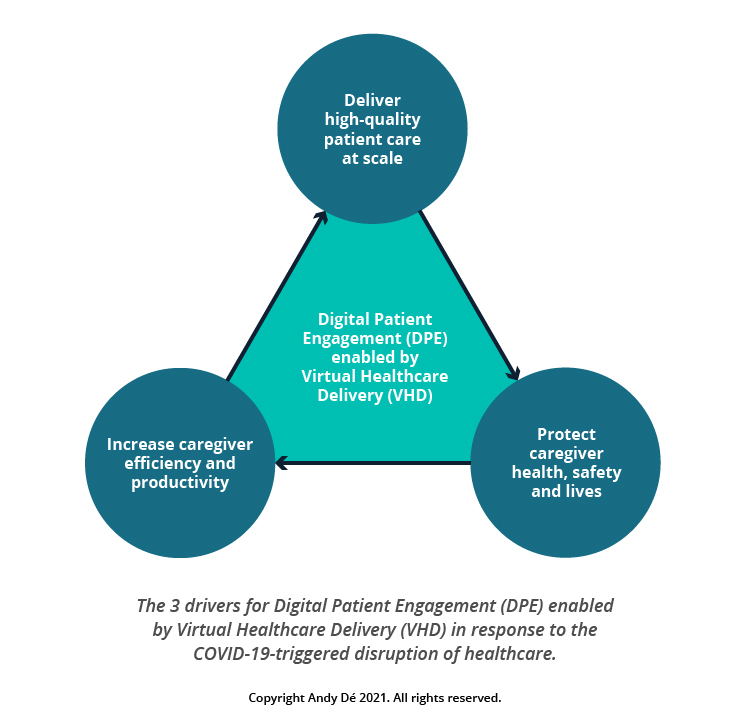
Protecting the health, well-being and safety of healthcare practitioners and first responders is paramount — and will accelerate adoption of Digital Patient Engagement (DPE), enabled by Virtual Healthcare Delivery (VHD) solutions (also known as “Hospital at Home.)”
As pictured below, there are three primary drivers for DPE and VHD:
- A clear need to deliver high quality healthcare to a massive number of patients afflicted with a contagious disease and co-morbidities.
- Risks presented by acquiring COVID-19 combined with continued lack of sufficient equipment, PPE, and rest for healthcare workers
- The need to minimize direct contact of providers with patients while increasing level of care efficiency and productivity
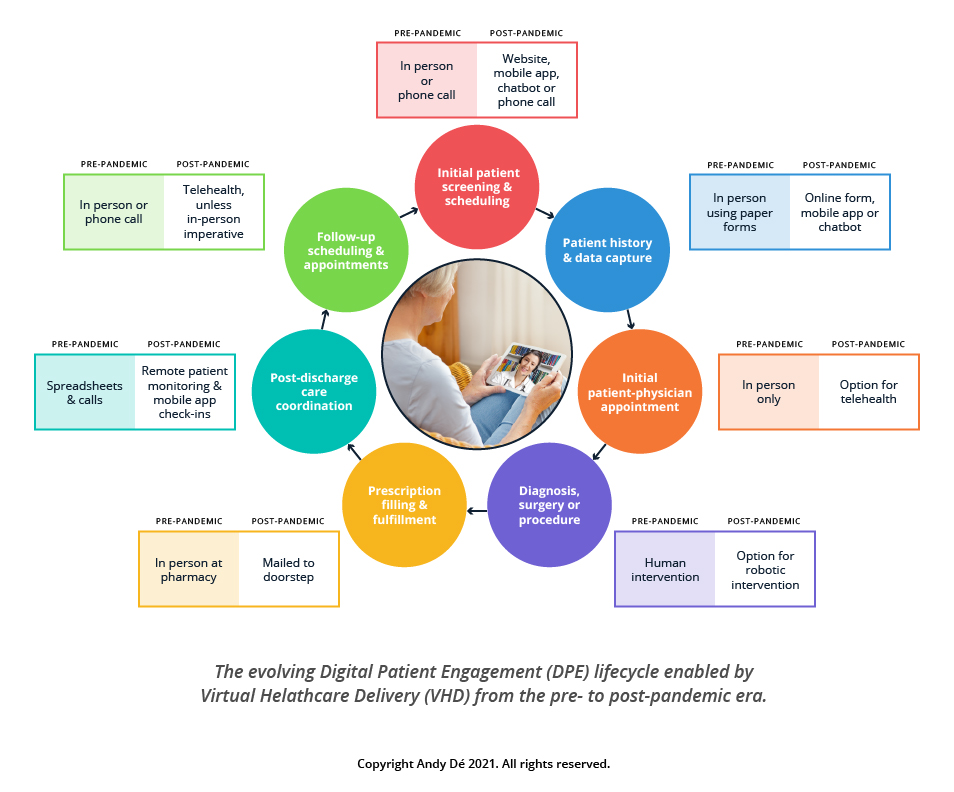
When I have this conversation with healthcare colleagues, the next question I typically receive is: “Andy, this sounds great, but where do we start?” The chart below demonstrates several helpful examples of how technology can be used to transform typical patient interactions and needs:
If you’re interested in more details about how to actually make changes like the ones described above, reach out to start a conversation. Join me back here on the MedeAnalytics blog next week for Innovation implications #3: Artificial intelligence and machine learning for operations, revenue cycle and supply change management innovation and #4: Medical robotics.

Get our take on industry trends

Data and Social Determinants of Health
By Scott Hampel – I think a lot–and I’m not the only one–about how we can improve the ways we pull information from data. Data on its own is inert: just waiting to be understood and then used. And that’s a major challenge for many organizations. Data is often trapped in different applications with no easy or convenient way to extract it.
Read on...
Why Social Determinants Need Analytics for Success
Many challenges face healthcare’s underserved. There are issues with food, housing, reliable transportation, steady employment and more. Each contributes to and is one element of social determinants of health (SDH). In communities around the world, public and private organizations are taking steps to address SDH-related issues and challenges that negatively impact healthcare.
Read on...
Healthcare Organizations Recognize Importance of AI for Reporting
Healthcare providers continue to recognize the value of using AI in reporting operations throughout the organization. AI has many strengths when applied to the healthcare industry:
Read on...
Why It’s Time for Healthcare to Move Toward AI Reporting
Business intelligence (BI) was a dramatic and significant step forward in healthcare industry reporting and a natural transition to artificial intelligence (AI) enabled real-time insights.
Read on...